


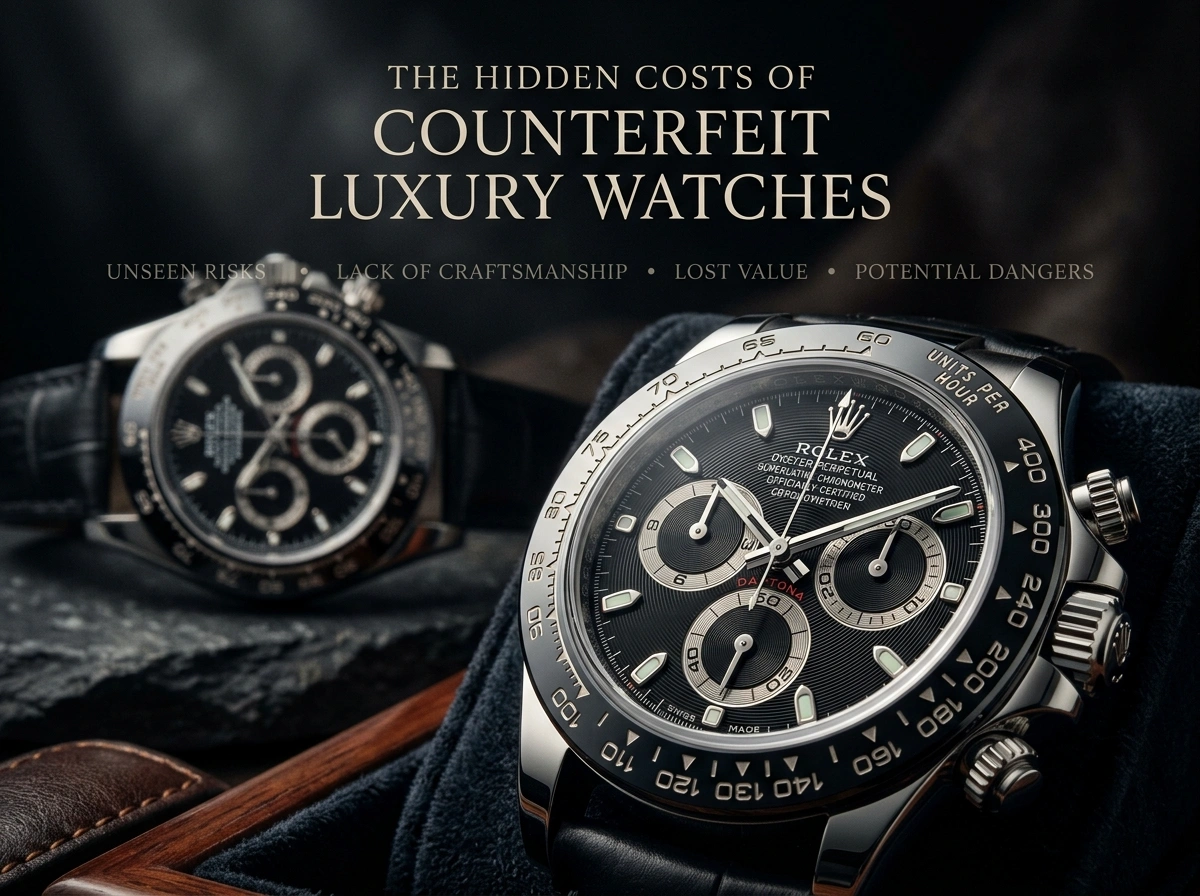
A luxury watch is more than a way to tell time. It signals craftsmanship, heritage, and personal achievement. That prestige is exactly why counterfeiters have built a thriving global trade around fake timepieces. At first glance, a counterfeit Rolex or Patek Philippe seems like a clever shortcut—the look you want at a fraction of the price. But the savings rarely hold up under scrutiny. Behind that attractive sticker price sits a long list of hidden costs that touch your wallet, your legal standing, your safety, and even your reputation. This article unpacks those costs so you can make a clearer, more informed decision before you buy.
The Real Financial Cost Behind the Bargain
The most obvious appeal of a counterfeit watch is the discount. Yet the math almost never works in your favor over time. A fake may cost a few hundred dollars, but it delivers little lasting value. Mechanical movements in counterfeits are often cheap quartz substitutes or low-grade clones that fail within months. When they break, repair is rarely possible because authorized service centers will not touch a fake, and few independent watchmakers want the liability.
So you pay again—either for repairs that never quite work or for a replacement that follows the same downward spiral. Compare that to a genuine timepiece, which can hold or even grow its value across decades. A counterfeit, by contrast, depreciates to nearly nothing the moment you walk away with it. What looked like a smart saving becomes a recurring expense with no return.
There is also the opportunity cost. Money spent on a fake is money you could have set aside toward an authentic entry-level luxury watch or a pre-owned model from a reputable dealer. Those options offer real ownership, real support, and the chance to recover your investment later.
Poor Craftsmanship and Short Lifespans
Authentic luxury watches earn their price through precision engineering, hand-finishing, and rigorous quality control. Counterfeits skip nearly all of it. The materials tend to be inferior: plated alloys instead of solid stainless steel or gold, mineral glass instead of sapphire crystal, and seals that fail to keep out water or dust.
These shortcuts show up quickly in daily use. Bezels loosen, lume fades, clasps snap, and movements lose accuracy. A genuine watch is built to survive years of wear and be serviced for generations. A counterfeit is built to survive the sale. The gap between how a fake looks in a photo and how it performs on your wrist is often dramatic, and that gap widens with every passing month.
No Warranty, No Service, No Resale Value
When you buy authentic, you buy a relationship. Reputable brands stand behind their products with warranties, certified servicing, and a documented chain of ownership. Counterfeits offer none of this. If the movement stops, you have no recourse. There is no warranty card that means anything, no service network, and no manufacturer accountability.
Resale tells the same story. The genuine pre-owned market thrives because buyers trust authenticity, paperwork, and brand support. A counterfeit has no legitimate resale path. You cannot sell it honestly as the real thing, and selling it as a fake exposes you to legal and ethical problems. In practical terms, the watch is a dead-end asset the moment you own it.
Legal and Customs Risks You Cannot Ignore
Counterfeit goods violate trademark and intellectual property laws in most countries. While casual buyers are not usually the primary target of enforcement, the risks are still real—especially when buying across borders. Customs authorities routinely seize counterfeit watches, and travelers can have items confiscated without compensation. In some jurisdictions, importing counterfeit goods can trigger fines or other penalties.
The risk grows sharply if you resell. Selling counterfeits is a serious offense that can lead to legal action, financial penalties, and lasting consequences. Even gifting a fake can create awkward or damaging situations if the recipient discovers what it is. The cost here is not just money—it is exposure to legal trouble that far outweighs any initial saving.
Cybersecurity and Scam Risks When Buying Online
The counterfeit watch trade has moved heavily online, and that shift introduces a new layer of danger. Many fake-watch websites operate with little oversight, weak security, and no real accountability. Handing over your credit card or personal details to such a site can expose you to fraud, identity theft, and unauthorized charges.
Some sites take payment and simply never ship anything. Others harvest data or push you toward sketchy payment methods that offer no buyer protection. The very nature of the market—operating in legal gray zones—means there is rarely anyone to complain to when things go wrong. Even browsing certain marketplaces, including those advertising a replica rolex, highlights how easy it is to wander into transactions with no consumer safeguards. The financial and personal data risks attached to these purchases are frequently underestimated until it is too late.
The Reputational Damage Few People Consider
A watch is a personal statement, and that cuts both ways. Wearing an authentic piece communicates taste and credibility. Wearing a counterfeit, once discovered, can do the opposite. In professional and social circles where people recognize genuine timepieces, a fake can quietly undermine the impression you are trying to create.
Watch enthusiasts and collectors often spot counterfeits at a glance—through the movement, the weight, the finishing, or small inconsistencies on the dial. Being caught wearing a fake suggests you tried to project something you did not actually have. For business leaders, clients, and partners, that perception can erode trust in subtle but meaningful ways. The reputational cost is hard to measure, yet it can outlast the watch itself.
The Broader Ethical and Economic Impact
The hidden costs extend well beyond the individual buyer. The counterfeit trade is frequently linked to exploitative labor practices, unsafe working conditions, and broader criminal networks. When you buy a fake, you may unknowingly support operations that harm vulnerable workers and undermine fair commerce.
Counterfeiting also damages the legitimate economy. It drains revenue from brands that invest in research, design, and skilled craftsmanship, and it threatens the livelihoods of the artisans and employees who depend on that work. Genuine manufacturers fund apprenticeships, preserve traditional skills, and contribute to local economies. Counterfeits siphon value away from all of it while contributing nothing back. So the true price of a fake is paid not only by you, but by an entire ecosystem of honest work.
Making a Smarter Choice
The appeal of a counterfeit luxury watch is understandable, but the savings are an illusion. Once you account for poor durability, the absence of warranty or resale value, legal and customs exposure, online scam risks, reputational harm, and the wider ethical damage, the cheap option becomes the expensive one.
If owning a luxury watch matters to you, there are honest paths to get there. Consider quality microbrands, certified pre-owned models, or saving toward an authentic entry-level piece from a trusted retailer. These choices give you real value, genuine support, and something you can wear with confidence and even pass on someday.
In the end, a watch should reflect who you are—not a shortcut you hope no one notices. Choosing authenticity protects your money, your standing, and your peace of mind. That is a value no counterfeit can ever match.

